Blog

  • Houston Truck Accident Lawyer: What Makes Texas Cases Different

    Houston Truck Accident Lawyer: What Makes Texas Cases Different

    If you’ve been hit by a commercial truck in the Houston area, the lawyer you hire needs to understand three things that don’t apply in most other states: Texas’s HB 19 bifurcated trial rule for commercial vehicle cases, the state’s modified comparative negligence standard (the 51% bar), and the practical reality of litigating in Harris County and the surrounding district courts. A general personal injury attorney from outside Texas — or one who handles mostly car cases in Houston — won’t be equipped for the procedural maze that HB 19 created.

    The two-year statute of limitations on personal injury cases in Texas (codified at Tex. Civ. Prac. & Rem. Code § 16.003) is well known, but it isn’t the deadline that matters most. Evidence preservation is. The real clock starts the moment the crash happens, because trucking companies routinely send rapid-response teams to the scene within hours — and their insurers’ lawyers begin working before yours. A Houston truck accident lawyer who isn’t on the file within 48 hours of a serious crash is already behind.

    The HB 19 rule that changed truck cases in Texas

    Texas House Bill 19, which took effect September 1, 2021, fundamentally restructured how commercial truck lawsuits are tried in the state. Codified at Tex. Civ. Prac. & Rem. Code §§ 72.051–72.055, the law allows a defendant trucking company to demand a bifurcated trial — meaning the case is split into two phases:

    • Phase 1. The jury decides whether the truck driver was negligent and, if so, awards compensatory damages (medical bills, lost wages, pain and suffering).
    • Phase 2. Only if the plaintiff wins Phase 1, the jury then considers the trucking company’s direct liability (negligent hiring, training, supervision, maintenance) and any punitive damages.

    The defendant must file the motion for bifurcation within 120 days of filing their answer. Once requested, the court must grant it.

    What this means in practice: a significant portion of the most damaging evidence against trucking companies — prior safety violations, poor hiring practices, falsified logs, internal communications — is generally inadmissible in Phase 1. That evidence used to drive juries to award large verdicts on the spot. HB 19 made it harder.

    Why this requires a Houston-specific specialist

    The strategic and procedural implications of HB 19 are real. A truck accident lawyer working in Houston needs to:

    • Know how to admit company-level evidence in Phase 1 anyway. Section 72.053 allows evidence of regulatory violations in Phase 1 if the violation was a proximate cause of the injury and the regulation is specific to the defendant or the vehicle. Building that argument requires knowing exactly which FMCSR violations apply.
    • Use FMCSA Section 72.054(c) exceptions for federally regulated carriers. Most interstate truckers fall under federal motor carrier rules, which preserve certain plaintiff-friendly evidence in Phase 1.
    • Strategically frame causation early. A lawyer who doesn’t anticipate bifurcation when filing the lawsuit can find their case stripped of leverage by motion practice.

    Texas’s 51% bar rule

    Texas follows a modified comparative negligence standard. If you’re found to be 51% or more at fault for the crash, you recover nothing. If you’re 50% or less at fault, your recovery is reduced by your percentage of fault.

    Your Fault Recovery
    0% Full damages
    20% 80% of damages
    49% 51% of damages
    50% 50% of damages
    51% or more Nothing

    This makes early defense narratives extremely dangerous. If a trucking company can credibly assign just over half the fault to the injured driver, the entire case collapses. A good Houston truck accident lawyer attacks this narrative aggressively from week one.

    Local Houston factors

    Truck traffic in the Houston region is unusually heavy because of:

    • Interstate 10 and Interstate 45 corridors moving cargo east-west and north-south.
    • The Port of Houston, one of the largest ports in the U.S., generating constant container-truck activity.
    • The Energy Corridor and refinery traffic creating dense commercial vehicle movement around west and east Houston.
    • Beltway 8 and the Sam Houston Tollway as primary trucking arteries.

    A Houston-based truck accident lawyer is familiar with which courts the case might land in (Harris County district courts, possibly federal court if there’s diversity jurisdiction), local defense firms, and the typical demeanor of Houston juries — which has shifted over the past decade.

    Questions to ask a Houston truck accident lawyer

    • How many commercial vehicle cases have you handled post-HB 19?
    • What’s your strategy for getting company-level evidence admitted in Phase 1?
    • Are you in Harris County district courts regularly?
    • Who is your in-house or contracted accident reconstructionist?
    • Have you tried a truck case to verdict since 2021?

    The lawyers who specialize in this area answer these questions in detail. Generalists hesitate.

    This article is for general information and is not legal advice. If you’ve been involved in a truck accident in Texas, consult promptly with a licensed Texas attorney about your specific situation.

  • Best Auto Accident Lawyer: A Timeline of What They Actually Do for You

    Best Auto Accident Lawyer: A Timeline of What They Actually Do for You

    The best auto accident lawyer isn’t just someone who shows up at the end to negotiate a settlement — it’s someone whose work matters most in the first 30 days after the crash and again at very specific later points in your case. Understanding that timeline is how you tell a competent attorney from a passive one, and how you avoid the most common mistake injured drivers make: hiring late and losing leverage they didn’t know they had.

    If you’ve been in an auto accident, what your lawyer does in week one usually determines what your case is worth in month twelve. Below is the actual timeline of what a good auto accident lawyer handles, what you should expect from them at each stage, and the deadlines that don’t wait for anyone.

    Days 1 to 7: Evidence and medical foundation

    This window is where cases are won or lost, and most victims don’t realize it. A good auto accident lawyer is doing the following before the bruises have faded:

    • Sending preservation letters. To the other driver’s insurer, any commercial entity involved, and businesses with potential surveillance footage. Camera systems often overwrite within 30 days; some within 72 hours.
    • Securing the police report. Filed reports sometimes contain errors that need correcting before insurance adjusters lock them into their evaluation.
    • Documenting injuries medically. Without contemporaneous medical records, insurers argue your injuries weren’t caused by the crash. Even minor pain should be documented at urgent care or a doctor’s office in week one.
    • Photographing the vehicles before repair. Insurance companies push fast repair to control narratives. Your lawyer wants photos of damage from every angle before that happens.
    • Talking to witnesses while their memory is fresh.

    Days 8 to 30: Investigation and insurance posture

    The middle of the first month is when your lawyer establishes the relationship with the at-fault driver’s insurer:

    • Sending the formal letter of representation (which stops the insurer from contacting you directly).
    • Opening the claim, requesting policy limits, and identifying all available coverage (the at-fault driver’s policy, your own underinsured motorist coverage, umbrella policies).
    • Beginning the demand package — the document that will eventually drive settlement negotiations.

    This is also when you, the client, should be in active medical treatment if injured. Settlement value tracks medical documentation. A lawyer who tells you to “just rest and call us when you’re better” is missing the picture.

    Days 31 to 180: Treatment, demand, negotiation

    Most cases settle in this window. The pattern usually goes:

    • You complete your medical treatment or reach maximum medical improvement (MMI) — the point where further treatment won’t significantly change your condition.
    • Your lawyer compiles a demand package: medical records, bills, lost wage documentation, and a written argument for damages.
    • The insurer responds with an initial offer (usually low).
    • Two to four rounds of negotiation follow.

    A good auto accident lawyer doesn’t accept the first offer and doesn’t rush to settle just to close the file. They also tell you honestly whether their counter-demand is realistic or aspirational.

    Months 6 to 24: Lawsuit, if needed

    If the insurer won’t offer fair value, your lawyer files a lawsuit. From there:

    • Discovery phase (usually 6 to 12 months): depositions, document requests, expert reports.
    • Mediation (often before trial): a settlement conference with a neutral mediator. Many cases settle here.
    • Trial (rare in absolute terms — around 5% of auto accident cases): a jury or judge decides damages.

    Only attorneys who actually try cases regularly carry weight in this phase. Insurance companies track which lawyers settle reflexively and which will take a case to verdict.

    Key deadlines you can’t miss

    Deadline Typical Window
    Filing an insurance claim Most policies: within days to a week
    Reporting crash to your own insurer Usually 24 to 72 hours, even if not at fault
    Statute of limitations (personal injury) 1 to 6 years depending on state (often 2 to 3)
    Statute of limitations (property damage) Often longer than injury, sometimes shorter
    Uninsured motorist claim notice Sometimes 30 to 60 days
    Government claims (if a government vehicle was involved) Often 30 to 180 days — much shorter than regular cases

    The government-claim deadline trap is real. If a city bus or police vehicle was involved, you may have only weeks to file a formal notice — long before the regular statute of limitations would expire.

    What separates a good lawyer from an average one

    Two things, mostly:

    • They move fast in the first 30 days. If your lawyer can’t tell you exactly what they did in your first week, they probably didn’t do much.
    • They prepare every case as if it might go to trial. Even though most settle, the ones that get top-tier settlements are the ones the insurer believes will actually be tried.

    This article is for general information and is not legal advice. Consult with a licensed attorney about your specific situation.

  • Trucking Accident Lawyer: Why the Most Important Evidence Lives in Federal Records

    Trucking Accident Lawyer: Why the Most Important Evidence Lives in Federal Records

    The most important documents in a trucking accident case are rarely at the crash scene. They’re in the carrier’s compliance files: electronic logging device data, hours-of-service records, drug and alcohol test results, driver qualification files, and vehicle inspection reports. A trucking accident lawyer who knows how to identify, preserve, and use these federal records is the difference between a settlement based on the police report and one built on documented regulatory violations — and the gap between those two outcomes is often hundreds of thousands of dollars.

    This is why “personal injury lawyer” and “trucking accident lawyer” are not interchangeable terms. Commercial vehicle cases are governed by the Federal Motor Carrier Safety Regulations (FMCSR) on top of state law, and finding violations requires knowing exactly what to ask for, when to ask for it, and how the trucking company is required to retain it.

    The federal records that often decide cases

    Commercial carriers operating in interstate commerce are required by FMCSA to keep specific records. Here’s what an experienced trucking accident lawyer goes after immediately:

    Record What It Shows Retention Period
    Electronic logging device (ELD) data Hours driven, on-duty time, exact location/time of stops 6 months (driver must retain 8 days)
    Driver qualification file License, medical certification, training, employment history Duration of employment + 3 years
    Drug and alcohol test results Pre-employment, random, post-accident testing 1 to 5 years depending on test type
    Driver vehicle inspection reports (DVIRs) Pre-trip and post-trip mechanical checks 3 months
    Maintenance records All repairs, inspections, parts replacements 1 year (12 months for current vehicles)
    Hours of service logs Historical driving and rest time 6 months
    Dispatch records Loads assigned, deadlines, routes Varies
    Post-accident testing Drug and alcohol screening after the crash Required within specific time windows

    Notice the retention periods. DVIRs and ELD records can be lawfully destroyed in as little as three to six months. If a trucking accident lawyer doesn’t send a preservation (spoliation) letter within days of the crash, these documents may legally disappear before discovery begins.

    The hours-of-service rules

    Driver fatigue is a leading factor in commercial truck crashes. FMCSA limits driving time through three main rules that trucking accident lawyers know cold:

    • 11-hour driving limit. A driver may drive up to 11 hours after 10 consecutive hours off duty.
    • 14-hour on-duty limit. A driver may not drive after the 14th hour following the start of the work day, even with breaks.
    • 70-hour/8-day limit (or 60-hour/7-day). Total on-duty time may not exceed 70 hours in any 8 consecutive days for carriers operating every day.
    • 30-minute break. Required after 8 cumulative hours of driving.

    When ELD data shows a driver exceeded these limits before the crash, the case fundamentally changes. Hours-of-service violations are direct, documented evidence of unsafe operation — and federal courts have repeatedly admitted them as proof of negligence.

    How violations become leverage

    A trucking accident lawyer doesn’t just collect compliance records — they use them strategically. A few patterns that recur:

    • Driver fatigue. ELD data showing hours-of-service violations near the time of the crash typically increases settlement value substantially.
    • Negligent hiring. A driver qualification file revealing prior crashes, failed drug tests, or suspended CDLs at hire date opens the door to direct negligence claims against the trucking company itself.
    • Improper maintenance. A maintenance log showing skipped or delayed inspections can support claims of negligent maintenance — often against both the carrier and a third-party contractor.
    • Falsified logs. When paper logs and ELD data don’t match, or when fuel receipts contradict the driver’s recorded location, that pattern alone can swing a jury.

    Why most general PI firms struggle here

    A general personal injury attorney might handle a few truck cases a year. Trucking accident lawyers — those who specialize — handle them every week. The practical difference shows up in three places:

    • Knowing what to demand and when. The first 30 days of evidence preservation determine what’s available at trial.
    • Knowing what the records mean. A DVIR with checkmarks looks fine to a non-specialist. A specialist notices that the same brake issue was flagged and then unflagged across multiple inspections.
    • Knowing which experts to retain. Trucking safety experts, accident reconstructionists, biomechanical engineers, vocational economists — the right combination depends on the facts.

    The bottom line for victims

    If you’ve been hurt in a trucking accident, the first practical question isn’t “should I hire a lawyer?” — it’s “how quickly can I hire one who actually does this work?” Get a free consultation within the first week if possible. Ask about FMCSR familiarity and spoliation procedures specifically. The lawyers who do this every day will know exactly what you’re asking.

    This article is for general information and is not legal advice. Consult with a licensed attorney in your state about your specific situation.

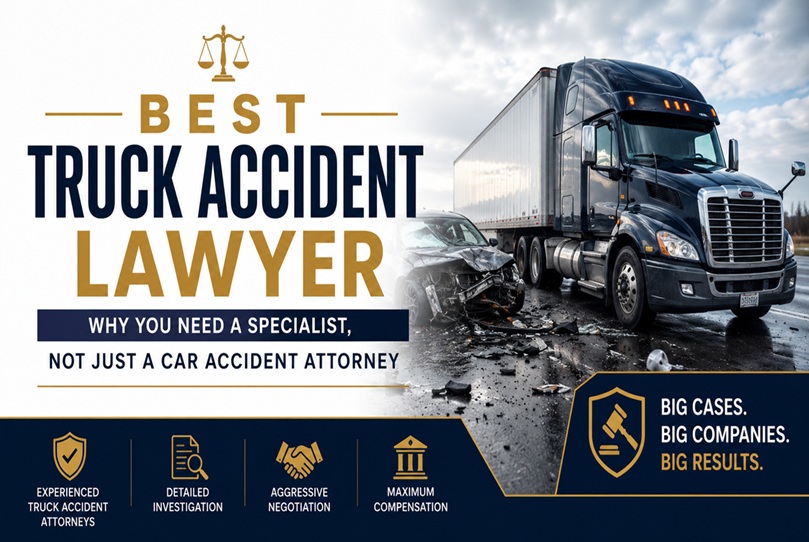
  • Best Truck Accident Lawyer: Why You Need a Specialist, Not Just a Car Accident Attorney

    Best Truck Accident Lawyer: Why You Need a Specialist, Not Just a Car Accident Attorney

    A truck accident isn’t just a bigger car accident – it’s a different legal case entirely, and the best truck accident lawyer is one who handles commercial vehicle cases as a primary practice area. The differences come down to four things: multiple potential defendants instead of one, federal regulations layered on top of state law, far higher insurance limits, and evidence that disappears within days unless an attorney moves immediately.

    If you’ve been hit by a commercial truck, the most important hire is not the lawyer with the cheapest contingency fee or the friendliest first call – it’s the one who has fought trucking companies and their insurers before and knows exactly which records to preserve, which experts to call, and which defendants to name. A general personal injury attorney can sometimes handle the case, but the learning curve on a complex truck case often costs more in settlement value than they save you in fees.

    How truck cases differ from car cases

    The differences are structural, not just a matter of degree:

    Issue Car Accident Truck Accident
    Potential defendants The other driver, sometimes their employer Driver, motor carrier, broker, shipper, maintenance contractor, parts manufacturer
    Insurance limits State minimums of $25K–$50K typical Federal minimum of $750K; often $1M–$5M+
    Governing law State traffic law State law + FMCSA federal regulations
    Key evidence Police report, witness statements Electronic logging devices, driver qualification files, maintenance records, drug/alcohol tests
    Evidence preservation Days to weeks Hours to days (some records can be lawfully destroyed within 6 months)

    A car accident attorney who doesn’t know to send a spoliation letter to the trucking company within 48 hours can lose critical evidence before the file even gets opened.

    Multiple defendants change everything

    In a car accident, you typically sue the other driver and recover from their insurance. In a truck accident, the path to compensation often runs through several parties:

    • The driver. Direct liability for negligence behind the wheel.
    • The motor carrier (trucking company). Vicariously liable for the driver, and often directly liable for negligent hiring, training, supervision, or maintenance.
    • The broker or shipper. Sometimes liable if they pressured unsafe schedules or improperly loaded cargo.
    • A maintenance contractor. Liable if mechanical failure contributed to the crash.
    • A parts or equipment manufacturer. Liable for defective brakes, tires, or safety systems.

    Identifying every responsible party – and the insurance policy that covers each – is what separates a $200,000 settlement from a $2 million one in similar cases.

    Federal regulations create extra leverage

    Commercial trucks operating in interstate commerce are governed by the Federal Motor Carrier Safety Regulations (FMCSR), administered by FMCSA. These rules cover:

    • Hours of service (how long a driver can be on duty)
    • Electronic logging device (ELD) requirements
    • Driver qualification and licensing
    • Drug and alcohol testing
    • Vehicle inspection and maintenance
    • Cargo securement
    • Hazardous materials handling

    A violation of any of these regulations isn’t just bad practice – it’s often admissible as evidence of negligence per se in court. A good truck accident lawyer pulls every relevant compliance record early and uses violations as leverage in settlement negotiations.

    What “specialist” actually means

    When evaluating a truck accident attorney, ask specifically:

    • How many commercial vehicle cases have you handled in the last three years?
    • Do you have an in-house investigator who can respond to a crash scene the same day?
    • What experts do you typically retain (accident reconstructionist, trucking safety expert, biomechanical engineer)?
    • Have you taken truck cases to trial? When was the last one?
    • Are you familiar with FMCSR – specifically Parts 391, 392, 395, and 396?

    Vague answers to any of these are a signal. Specialists answer these questions in their sleep.

    The speed factor

    The single biggest mistake people make after a truck accident is waiting. Trucking companies have rapid-response teams – investigators, attorneys, and adjusters who arrive at the scene within hours, sometimes before the victim has even left the emergency room. Their job is to begin building a defense and limit the company’s exposure.

    A truck accident lawyer should be on the case within the first 48 hours after a serious crash. That window is when scene evidence, witness memories, and electronic data are still preservable. Wait two weeks and a meaningful portion of the case may already be gone.

    This article is for general information and is not legal advice. If you’ve been involved in a truck accident, consult with a licensed attorney in your state.

  • Best Motorcycle Accident Lawyer: Why Fighting Bias Matters More Than Anything Else

    Best Motorcycle Accident Lawyer: Why Fighting Bias Matters More Than Anything Else

    The single biggest hurdle in a motorcycle accident case is not the law, the evidence, or even the injuries — it’s the assumption, often held quietly by insurance adjusters and jurors, that the rider must have been reckless, speeding, or otherwise partly to blame. The best motorcycle accident lawyer is the one who knows how to counter that bias systematically, using crash data, expert testimony, and case framing that humanizes the rider before the other side has a chance to caricature them.

    This bias is documented and persistent. Insurance company training materials, jury research, and accident statistics all show the same pattern: in cases where a motorcyclist was hit by a car driver who clearly violated the right of way, fault is still disputed roughly half the time. That’s not because the facts are unclear. It’s because the cultural assumption that “bikers are dangerous” leaks into how investigations are conducted, how settlement offers are calculated, and how juries deliberate. A specialized motorcycle accident lawyer plans for this from the first phone call.

    What the actual data shows

    According to NHTSA data, the most common cause of motorcycle crashes involving another vehicle is the other vehicle violating the motorcyclist’s right of way — typically a left turn across the motorcycle’s path. The driver “didn’t see” the rider, despite the rider being lawfully in their lane. In federal accident studies, more than half of multi-vehicle motorcycle crashes are caused by the other driver’s failure to yield, distracted driving, or improper lane change.

    A motorcycle accident lawyer who knows this data brings it into the case explicitly:

    • Crash reconstruction that uses time-distance analysis to show the motorcyclist had the right of way and reasonable speed.
    • Cell phone records subpoenaed from the at-fault driver, which often show the driver was on their device at the time of impact.
    • Visibility analysis — was the rider wearing high-visibility gear, was their headlight functional, were sight lines clear?
    • Expert testimony from a motorcycle safety instructor or accident reconstructionist who can explain rider behavior in ways non-riding jurors don’t intuitively understand.

    The lane-splitting and helmet narratives

    Two recurring tactics used against motorcyclists:

    • The lane-splitting argument. In states where lane splitting is illegal, the defense will try to paint the rider as reckless even if lane splitting had nothing to do with the crash. Where it’s legal (California, Utah, Arizona, and growing), the defense pivots to “lane filtering at unsafe speeds” arguments. A good attorney shuts these down with precise reconstruction.
    • The helmet defense. Even in states with universal helmet laws, defense lawyers sometimes argue that the rider’s injuries could have been worse without one — implying the rider had a death wish for riding at all. In states without universal helmet laws, the defense argues that not wearing one constitutes contributory negligence for head injuries.

    Specialized motorcycle accident attorneys have rehearsed responses to both. Generalists often haven’t.

    Insurance company tactics worth knowing

    Insurers handle motorcycle claims with predictable patterns. Some to watch for:

    • Quick lowball offers within days of the crash, before the rider knows the extent of their injuries (motorcycle injuries often worsen significantly in the weeks following — internal bleeding, soft tissue damage, traumatic brain injury symptoms that emerge later).
    • Recorded statements requested early, with questions designed to elicit admissions (“Were you going the speed limit?” “Did you see the driver before the impact?”).
    • Surveillance of the injured rider’s social media and physical movements to dispute injury claims.
    • Comparative fault inflation — assigning the rider 30% or 40% of fault on thin evidence to shrink the payout.

    A good motorcycle accident lawyer prepares the client for all of this before the insurer makes contact.

    What to ask in a consultation

    Question Why It Matters
    What percentage of your caseload is motorcycle cases? Specialists handle these every month, not once a year
    Do you ride? Not required, but riders understand the dynamics
    What expert witnesses do you typically retain? Reconstructionist, motorcycle safety expert, biomechanical engineer, vocational economist
    How do you handle the comparative fault argument? They should have a clear, rehearsed answer
    Have you tried a motorcycle case to verdict? Critical leverage — insurers track who actually goes to trial
    What’s your communication policy? Weekly updates, named point of contact

    The cost of hiring a generalist

    A general personal injury attorney can absolutely handle a motorcycle case. The question is whether they’ll handle it well. The hidden cost shows up in settlement value — cases that should resolve at $400,000 often settle for $150,000 because the lawyer didn’t fight the bias arguments hard enough, didn’t retain the right experts, or didn’t preserve the visual evidence that proves the at-fault driver had a clear line of sight.

    If you’ve been hurt in a motorcycle accident, the cost of finding a specialist is the same as the cost of hiring a generalist — both typically work on contingency. The difference in outcome can be enormous.

    This article is for general information and is not legal advice. If you’ve been in a motorcycle accident, consult with a licensed attorney in your state.

  • How Insurance Lawyer Help in Negotiating Fair Claim Settlements Quickly?

    How Insurance Lawyer Help in Negotiating Fair Claim Settlements Quickly?

    Discussing a claim may be disorienting when the rules are not clear, and we have to wait to get an answer. Proper guidance assists individuals in appreciating their rights and taking proper action when there is a dispute. Legal support makes sure that the documents are kept up to date and communication is clear throughout the process. Experts go through the minutiae to ensure that no bit of the claim is overlooked or underestimated. They also strive to minimize the delays as well as guard their interests in negotiations.

    Good Legal Support Leads to a better outcome.

    Omar Ochoa Law Firm provides professional advice on how to arrange claim information to be fairly evaluated and for a superior outcome, to be effectively communicated with throughout the settlement process.

    Proper Documentation reinforces all cases.

    Good records assist in putting facts on the table, substantiating claims with facts, and making sure that every detail is put in consideration during settlement discussions to achieve improved results.

    Proper Assessment will avoid losses.

    Close consideration makes the value of claims reflect the actual impact and helps to avoid underpayment and achieve fair results with the help of strong negotiation support.

    Early Intervention Cuts Down on Time.

    Quick response assists in the progress of discussions, eliminates needless waiting, and makes sure that the progress in settlement is both effective and efficient.

    Strategic Planning Enhances the ability to negotiate.

    Proper planning helps to recognize key points, strengthen a stand, and helps to maintain a clear direction to achieve fair settlement results.

    Better Recovery is Enhanced by Fair Settlement.

    Equity results in the recovery of individuals in the right manner, diminishes stress, and also promotes a stabilized normal activity after resolution.

    Professional Help Leads to increased clarity.

    Guidance also provides good direction, aids in making sound decisions, and helps a person remain confident in the overall settlement process.

    Fast Tracked Steps Enhance Claim Process.

    Begin with an early start and good advice so that the claim handling process can be smooth and that settlement results can be quick and clear through an organized and systematic approach.

    • Make sure that you have all the documents that relate to the claim so that there is no chance that you might not have all the documents that are relevant to the claim at all times.

    Quicker Ways To achieve quicker Results.

    Use easy procedures to enhance the advancement of claims and facilitate faster settlement by implementing structured activities and continuity in communications.

    • Keep proper records to prove your argument and to guarantee that all your details are well tabulated during settlement discussions to achieve better results.
    • Stay updated on what your rights are so that you can react appropriately and prevent any mistakes that may be present in the value of the claim during negotiation.

    An excellent use of claims necessitates clear planning, constant action, and appropriate support in all stages of the process. Effective guidance assists in upholding accuracy, minimizes confusion, and guarantees improved results. Addressing an Insurance Lawyer Fort Worth will guarantee the stable development and help to attain a fair outcome without additional issues.

  • Choosing Experienced Attorneys for Handling Multi-Vehicle Collision Liability Disputes

    Choosing Experienced Attorneys for Handling Multi-Vehicle Collision Liability Disputes

    When several parties are involved in a road incident, it often leads to confusion about who is responsible. A lawyer helps guide people through multiple claims while making sure fairness is maintained throughout the process. Proper direction from a knowledgeable professional reduces mistakes and keeps everything structured. With the right support, individuals can handle the situation with better understanding and a sense of control, as trusted resources like pilaw.com can further support informed decision-making.

    How Legal Skills Influence Outcomes?

    Strong legal ability can shape the direction of a claim involving multiple sides. A seasoned lawyer applies practical insight to manage difficult situations and address opposing points with clarity. This kind of preparation helps keep complicated matters under control. Clear direction in each step supports better decision making and increases the possibility of a balanced result.

    Can Evidence Change Liability Decisions?

    Reliable details carry strong weight when deciding responsibility in such matters. A lawyer reviews reports, statements, and related documents to form a solid argument. Well-presented facts help limit confusion and guide fair decisions. Close review can reveal missing points or inconsistencies within different claims.

    Handling Communication With Multiple Parties

    Dealing with several individuals at once requires patience and clarity. A lawyer ensures that every message is conveyed properly without creating misunderstandings. Clear communication helps maintain order during tense situations.

    • Clear updates help everyone stay informed throughout the claim process
    • Calm interaction reduces tension among all involved claim participants
    • Consistent messaging avoids confusion during important legal discussions
    • Proper coordination ensures each step moves forward without delay
    • Respectful tone builds trust between all parties involved

    Organizing Complex Claim Procedures

    Managing several claims together requires careful planning and structured steps. A lawyer handles documents, timelines, and interactions with precision. This organized method prevents missed details and reduces confusion. Efficient handling ensures that each part of the claim progresses smoothly. The mention of Surgical Errors Lawyer New City shows how structured legal handling applies across various complex claim situations.

    Choosing Dependable Legal Support

    Selecting the right professional involves looking at reliability and commitment. A trustworthy lawyer explains each step clearly and provides steady guidance. Their approach helps maintain focus during challenging moments.

    • Clear guidance helps individuals understand each stage of the legal process
    • Honest communication reduces stress and builds strong client confidence
    • Consistent support ensures steady progress without unnecessary confusion
    • Organized work style improves handling of documents and timelines
    • Professional behavior maintains clarity during challenging legal situations

    Practical Steps For Better Outcomes

    Taking early steps and acting without delay can make a big difference in managing complicated claims. Keeping documents in order and staying in touch with all involved sides helps everything move more smoothly. Proper support ensures each duty is handled the right way. Being aware of each stage reduces confusion and prevents setbacks. Choosing a capable lawyer at the proper moment can strengthen the case and support a fair outcome for everyone involved.

    FAQs

    Why do multi-party claims take longer than single-party cases?

    More participants require a detailed review, which increases the time needed for resolution.

    How does clear communication help during complex liability claim processes?

    It prevents confusion, keeps progress steady, and supports better coordination among parties.

    What should be considered when selecting legal help for claims?

    Look for experience, clear guidance, and consistent support throughout the process.

  • Injury related claims and how legal awareness develops over time

    Injury related claims and how legal awareness develops over time

    It doesn’t really begin in a way people notice. Something happens, they deal with it, and for a while it just sits there as one of those things that didn’t go right but also didn’t feel big enough to think about again. Most people don’t go back and analyse it. They move on.

    Then later, when it doesn’t quite settle, that’s when it starts to feel different. Not suddenly. Just a slow shift. And during that phase, while looking around without a clear direction, people come across hht-law.com. Not because they were looking for legal help exactly. More like they were trying to understand what this situation even counts as.

    When it stays, but not in an obvious way

    It’s not always pain. Sometimes it’s just discomfort that shows up randomly. Certain movements feel off. Something feels slightly different and then normal again, then different again.

    That’s what makes it confusing. If it was constant, maybe it would be easier to react. But this kind of in-between feeling just keeps repeating without fully becoming something clear.

    And that’s where attention slowly starts to shift.

    Awareness doesn’t come in one clear moment

    There isn’t a point where someone suddenly understands what’s happening. It builds in pieces.

    A thought shows up. Then disappears. Then comes back again later when something reminds them. Maybe while doing something simple. Maybe while resting.

    It’s not structured. It doesn’t connect neatly. And for a while, it doesn’t even feel like it needs to.

    Looking at things that feel close to the situation

    People don’t go searching deeply at first. They look at what feels familiar. Something that sounds closer to what they experienced.

    That’s how something like a Tarzana Personal Injury Lawyer shows up. Not because they’ve decided anything. Just because it feels easier to read something that sounds like it could relate.

    Even then, it doesn’t lead anywhere immediately. It just stays as information.

    Trying to go back and understand the moment

    This part doesn’t really work the way people expect.

    They try to think back to what actually happened. The exact moment, the details, whether something was missed. But memory doesn’t always stay clear like that.

    Some parts feel sharp. Others feel like they’ve already faded. And the more they try to piece it together, the less confident it feels.

    That one thought that doesn’t leave completely

    There’s usually one question that keeps coming back. Not constantly, but enough.

    Could this have been avoided.

    It doesn’t stay in focus the whole time. It just shows up again, randomly, when something reminds them of it.

    Reading things without really knowing what applies

    People read things here and there. Not properly. Not in one go. Some of it makes sense. Some of it feels like it belongs to a different situation.

    So they stop. Then later, they check again. It doesn’t feel like progress. More like going in circles a bit.

    At some point, it comes up in conversation. Not fully explained, just mentioned. And that shifts something. It feels a bit more real after that. Not clearer, just harder to ignore in the same way.