Category: Motorcycle Accidents

  • Best Truck Accident Lawyer: Why You Need a Specialist, Not Just a Car Accident Attorney

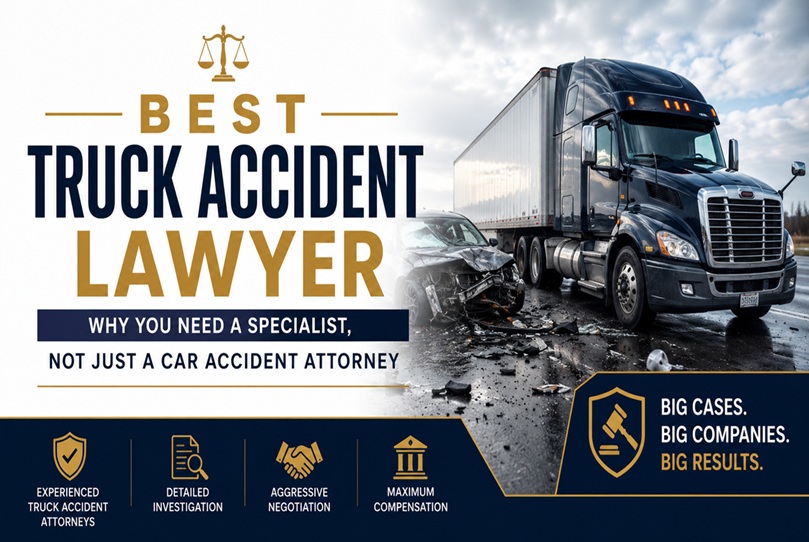
    Best Truck Accident Lawyer: Why You Need a Specialist, Not Just a Car Accident Attorney

    A truck accident isn’t just a bigger car accident – it’s a different legal case entirely, and the best truck accident lawyer is one who handles commercial vehicle cases as a primary practice area. The differences come down to four things: multiple potential defendants instead of one, federal regulations layered on top of state law, far higher insurance limits, and evidence that disappears within days unless an attorney moves immediately.

    If you’ve been hit by a commercial truck, the most important hire is not the lawyer with the cheapest contingency fee or the friendliest first call – it’s the one who has fought trucking companies and their insurers before and knows exactly which records to preserve, which experts to call, and which defendants to name. A general personal injury attorney can sometimes handle the case, but the learning curve on a complex truck case often costs more in settlement value than they save you in fees.

    How truck cases differ from car cases

    The differences are structural, not just a matter of degree:

    Issue Car Accident Truck Accident
    Potential defendants The other driver, sometimes their employer Driver, motor carrier, broker, shipper, maintenance contractor, parts manufacturer
    Insurance limits State minimums of $25K–$50K typical Federal minimum of $750K; often $1M–$5M+
    Governing law State traffic law State law + FMCSA federal regulations
    Key evidence Police report, witness statements Electronic logging devices, driver qualification files, maintenance records, drug/alcohol tests
    Evidence preservation Days to weeks Hours to days (some records can be lawfully destroyed within 6 months)

    A car accident attorney who doesn’t know to send a spoliation letter to the trucking company within 48 hours can lose critical evidence before the file even gets opened.

    Multiple defendants change everything

    In a car accident, you typically sue the other driver and recover from their insurance. In a truck accident, the path to compensation often runs through several parties:

    • The driver. Direct liability for negligence behind the wheel.
    • The motor carrier (trucking company). Vicariously liable for the driver, and often directly liable for negligent hiring, training, supervision, or maintenance.
    • The broker or shipper. Sometimes liable if they pressured unsafe schedules or improperly loaded cargo.
    • A maintenance contractor. Liable if mechanical failure contributed to the crash.
    • A parts or equipment manufacturer. Liable for defective brakes, tires, or safety systems.

    Identifying every responsible party – and the insurance policy that covers each – is what separates a $200,000 settlement from a $2 million one in similar cases.

    Federal regulations create extra leverage

    Commercial trucks operating in interstate commerce are governed by the Federal Motor Carrier Safety Regulations (FMCSR), administered by FMCSA. These rules cover:

    • Hours of service (how long a driver can be on duty)
    • Electronic logging device (ELD) requirements
    • Driver qualification and licensing
    • Drug and alcohol testing
    • Vehicle inspection and maintenance
    • Cargo securement
    • Hazardous materials handling

    A violation of any of these regulations isn’t just bad practice – it’s often admissible as evidence of negligence per se in court. A good truck accident lawyer pulls every relevant compliance record early and uses violations as leverage in settlement negotiations.

    What “specialist” actually means

    When evaluating a truck accident attorney, ask specifically:

    • How many commercial vehicle cases have you handled in the last three years?
    • Do you have an in-house investigator who can respond to a crash scene the same day?
    • What experts do you typically retain (accident reconstructionist, trucking safety expert, biomechanical engineer)?
    • Have you taken truck cases to trial? When was the last one?
    • Are you familiar with FMCSR – specifically Parts 391, 392, 395, and 396?

    Vague answers to any of these are a signal. Specialists answer these questions in their sleep.

    The speed factor

    The single biggest mistake people make after a truck accident is waiting. Trucking companies have rapid-response teams – investigators, attorneys, and adjusters who arrive at the scene within hours, sometimes before the victim has even left the emergency room. Their job is to begin building a defense and limit the company’s exposure.

    A truck accident lawyer should be on the case within the first 48 hours after a serious crash. That window is when scene evidence, witness memories, and electronic data are still preservable. Wait two weeks and a meaningful portion of the case may already be gone.

    This article is for general information and is not legal advice. If you’ve been involved in a truck accident, consult with a licensed attorney in your state.

  • Best Motorcycle Accident Lawyer: Why Fighting Bias Matters More Than Anything Else

    Best Motorcycle Accident Lawyer: Why Fighting Bias Matters More Than Anything Else

    The single biggest hurdle in a motorcycle accident case is not the law, the evidence, or even the injuries — it’s the assumption, often held quietly by insurance adjusters and jurors, that the rider must have been reckless, speeding, or otherwise partly to blame. The best motorcycle accident lawyer is the one who knows how to counter that bias systematically, using crash data, expert testimony, and case framing that humanizes the rider before the other side has a chance to caricature them.

    This bias is documented and persistent. Insurance company training materials, jury research, and accident statistics all show the same pattern: in cases where a motorcyclist was hit by a car driver who clearly violated the right of way, fault is still disputed roughly half the time. That’s not because the facts are unclear. It’s because the cultural assumption that “bikers are dangerous” leaks into how investigations are conducted, how settlement offers are calculated, and how juries deliberate. A specialized motorcycle accident lawyer plans for this from the first phone call.

    What the actual data shows

    According to NHTSA data, the most common cause of motorcycle crashes involving another vehicle is the other vehicle violating the motorcyclist’s right of way — typically a left turn across the motorcycle’s path. The driver “didn’t see” the rider, despite the rider being lawfully in their lane. In federal accident studies, more than half of multi-vehicle motorcycle crashes are caused by the other driver’s failure to yield, distracted driving, or improper lane change.

    A motorcycle accident lawyer who knows this data brings it into the case explicitly:

    • Crash reconstruction that uses time-distance analysis to show the motorcyclist had the right of way and reasonable speed.
    • Cell phone records subpoenaed from the at-fault driver, which often show the driver was on their device at the time of impact.
    • Visibility analysis — was the rider wearing high-visibility gear, was their headlight functional, were sight lines clear?
    • Expert testimony from a motorcycle safety instructor or accident reconstructionist who can explain rider behavior in ways non-riding jurors don’t intuitively understand.

    The lane-splitting and helmet narratives

    Two recurring tactics used against motorcyclists:

    • The lane-splitting argument. In states where lane splitting is illegal, the defense will try to paint the rider as reckless even if lane splitting had nothing to do with the crash. Where it’s legal (California, Utah, Arizona, and growing), the defense pivots to “lane filtering at unsafe speeds” arguments. A good attorney shuts these down with precise reconstruction.
    • The helmet defense. Even in states with universal helmet laws, defense lawyers sometimes argue that the rider’s injuries could have been worse without one — implying the rider had a death wish for riding at all. In states without universal helmet laws, the defense argues that not wearing one constitutes contributory negligence for head injuries.

    Specialized motorcycle accident attorneys have rehearsed responses to both. Generalists often haven’t.

    Insurance company tactics worth knowing

    Insurers handle motorcycle claims with predictable patterns. Some to watch for:

    • Quick lowball offers within days of the crash, before the rider knows the extent of their injuries (motorcycle injuries often worsen significantly in the weeks following — internal bleeding, soft tissue damage, traumatic brain injury symptoms that emerge later).
    • Recorded statements requested early, with questions designed to elicit admissions (“Were you going the speed limit?” “Did you see the driver before the impact?”).
    • Surveillance of the injured rider’s social media and physical movements to dispute injury claims.
    • Comparative fault inflation — assigning the rider 30% or 40% of fault on thin evidence to shrink the payout.

    A good motorcycle accident lawyer prepares the client for all of this before the insurer makes contact.

    What to ask in a consultation

    Question Why It Matters
    What percentage of your caseload is motorcycle cases? Specialists handle these every month, not once a year
    Do you ride? Not required, but riders understand the dynamics
    What expert witnesses do you typically retain? Reconstructionist, motorcycle safety expert, biomechanical engineer, vocational economist
    How do you handle the comparative fault argument? They should have a clear, rehearsed answer
    Have you tried a motorcycle case to verdict? Critical leverage — insurers track who actually goes to trial
    What’s your communication policy? Weekly updates, named point of contact

    The cost of hiring a generalist

    A general personal injury attorney can absolutely handle a motorcycle case. The question is whether they’ll handle it well. The hidden cost shows up in settlement value — cases that should resolve at $400,000 often settle for $150,000 because the lawyer didn’t fight the bias arguments hard enough, didn’t retain the right experts, or didn’t preserve the visual evidence that proves the at-fault driver had a clear line of sight.

    If you’ve been hurt in a motorcycle accident, the cost of finding a specialist is the same as the cost of hiring a generalist — both typically work on contingency. The difference in outcome can be enormous.

    This article is for general information and is not legal advice. If you’ve been in a motorcycle accident, consult with a licensed attorney in your state.