

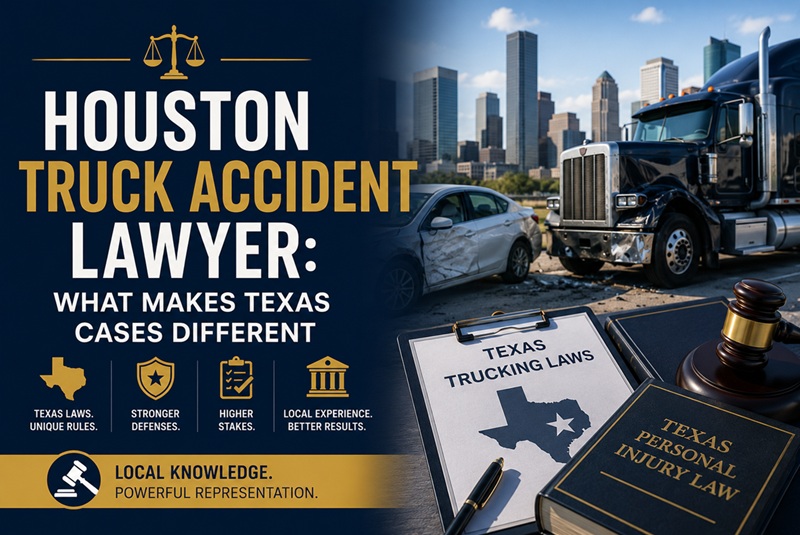
If you’ve been hit by a commercial truck in the Houston area, the lawyer you hire needs to understand three things that don’t apply in most other states: Texas’s HB 19 bifurcated trial rule for commercial vehicle cases, the state’s modified comparative negligence standard (the 51% bar), and the practical reality of litigating in Harris County and the surrounding district courts. A general personal injury attorney from outside Texas — or one who handles mostly car cases in Houston — won’t be equipped for the procedural maze that HB 19 created.
The two-year statute of limitations on personal injury cases in Texas (codified at Tex. Civ. Prac. & Rem. Code § 16.003) is well known, but it isn’t the deadline that matters most. Evidence preservation is. The real clock starts the moment the crash happens, because trucking companies routinely send rapid-response teams to the scene within hours — and their insurers’ lawyers begin working before yours. A Houston truck accident lawyer who isn’t on the file within 48 hours of a serious crash is already behind.
The HB 19 rule that changed truck cases in Texas
Texas House Bill 19, which took effect September 1, 2021, fundamentally restructured how commercial truck lawsuits are tried in the state. Codified at Tex. Civ. Prac. & Rem. Code §§ 72.051–72.055, the law allows a defendant trucking company to demand a bifurcated trial — meaning the case is split into two phases:
- Phase 1. The jury decides whether the truck driver was negligent and, if so, awards compensatory damages (medical bills, lost wages, pain and suffering).
- Phase 2. Only if the plaintiff wins Phase 1, the jury then considers the trucking company’s direct liability (negligent hiring, training, supervision, maintenance) and any punitive damages.
The defendant must file the motion for bifurcation within 120 days of filing their answer. Once requested, the court must grant it.
What this means in practice: a significant portion of the most damaging evidence against trucking companies — prior safety violations, poor hiring practices, falsified logs, internal communications — is generally inadmissible in Phase 1. That evidence used to drive juries to award large verdicts on the spot. HB 19 made it harder.
Why this requires a Houston-specific specialist
The strategic and procedural implications of HB 19 are real. A truck accident lawyer working in Houston needs to:
- Know how to admit company-level evidence in Phase 1 anyway. Section 72.053 allows evidence of regulatory violations in Phase 1 if the violation was a proximate cause of the injury and the regulation is specific to the defendant or the vehicle. Building that argument requires knowing exactly which FMCSR violations apply.
- Use FMCSA Section 72.054(c) exceptions for federally regulated carriers. Most interstate truckers fall under federal motor carrier rules, which preserve certain plaintiff-friendly evidence in Phase 1.
- Strategically frame causation early. A lawyer who doesn’t anticipate bifurcation when filing the lawsuit can find their case stripped of leverage by motion practice.
Texas’s 51% bar rule
Texas follows a modified comparative negligence standard. If you’re found to be 51% or more at fault for the crash, you recover nothing. If you’re 50% or less at fault, your recovery is reduced by your percentage of fault.
| Your Fault | Recovery |
|---|---|
| 0% | Full damages |
| 20% | 80% of damages |
| 49% | 51% of damages |
| 50% | 50% of damages |
| 51% or more | Nothing |
This makes early defense narratives extremely dangerous. If a trucking company can credibly assign just over half the fault to the injured driver, the entire case collapses. A good Houston truck accident lawyer attacks this narrative aggressively from week one.
Local Houston factors
Truck traffic in the Houston region is unusually heavy because of:
- Interstate 10 and Interstate 45 corridors moving cargo east-west and north-south.
- The Port of Houston, one of the largest ports in the U.S., generating constant container-truck activity.
- The Energy Corridor and refinery traffic creating dense commercial vehicle movement around west and east Houston.
- Beltway 8 and the Sam Houston Tollway as primary trucking arteries.
A Houston-based truck accident lawyer is familiar with which courts the case might land in (Harris County district courts, possibly federal court if there’s diversity jurisdiction), local defense firms, and the typical demeanor of Houston juries — which has shifted over the past decade.
Questions to ask a Houston truck accident lawyer
- How many commercial vehicle cases have you handled post-HB 19?
- What’s your strategy for getting company-level evidence admitted in Phase 1?
- Are you in Harris County district courts regularly?
- Who is your in-house or contracted accident reconstructionist?
- Have you tried a truck case to verdict since 2021?
The lawyers who specialize in this area answer these questions in detail. Generalists hesitate.
This article is for general information and is not legal advice. If you’ve been involved in a truck accident in Texas, consult promptly with a licensed Texas attorney about your specific situation.