

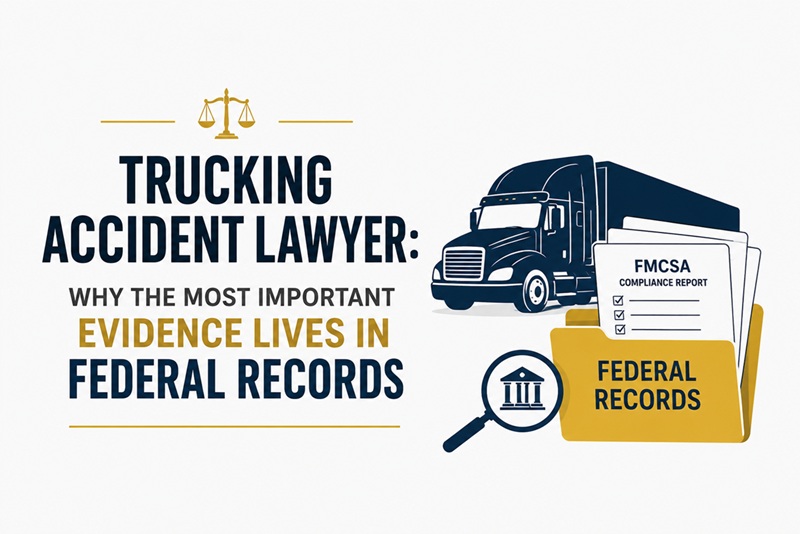
The most important documents in a trucking accident case are rarely at the crash scene. They’re in the carrier’s compliance files: electronic logging device data, hours-of-service records, drug and alcohol test results, driver qualification files, and vehicle inspection reports. A trucking accident lawyer who knows how to identify, preserve, and use these federal records is the difference between a settlement based on the police report and one built on documented regulatory violations — and the gap between those two outcomes is often hundreds of thousands of dollars.
This is why “personal injury lawyer” and “trucking accident lawyer” are not interchangeable terms. Commercial vehicle cases are governed by the Federal Motor Carrier Safety Regulations (FMCSR) on top of state law, and finding violations requires knowing exactly what to ask for, when to ask for it, and how the trucking company is required to retain it.
The federal records that often decide cases
Commercial carriers operating in interstate commerce are required by FMCSA to keep specific records. Here’s what an experienced trucking accident lawyer goes after immediately:
| Record | What It Shows | Retention Period |
|---|---|---|
| Electronic logging device (ELD) data | Hours driven, on-duty time, exact location/time of stops | 6 months (driver must retain 8 days) |
| Driver qualification file | License, medical certification, training, employment history | Duration of employment + 3 years |
| Drug and alcohol test results | Pre-employment, random, post-accident testing | 1 to 5 years depending on test type |
| Driver vehicle inspection reports (DVIRs) | Pre-trip and post-trip mechanical checks | 3 months |
| Maintenance records | All repairs, inspections, parts replacements | 1 year (12 months for current vehicles) |
| Hours of service logs | Historical driving and rest time | 6 months |
| Dispatch records | Loads assigned, deadlines, routes | Varies |
| Post-accident testing | Drug and alcohol screening after the crash | Required within specific time windows |
Notice the retention periods. DVIRs and ELD records can be lawfully destroyed in as little as three to six months. If a trucking accident lawyer doesn’t send a preservation (spoliation) letter within days of the crash, these documents may legally disappear before discovery begins.
The hours-of-service rules
Driver fatigue is a leading factor in commercial truck crashes. FMCSA limits driving time through three main rules that trucking accident lawyers know cold:
- 11-hour driving limit. A driver may drive up to 11 hours after 10 consecutive hours off duty.
- 14-hour on-duty limit. A driver may not drive after the 14th hour following the start of the work day, even with breaks.
- 70-hour/8-day limit (or 60-hour/7-day). Total on-duty time may not exceed 70 hours in any 8 consecutive days for carriers operating every day.
- 30-minute break. Required after 8 cumulative hours of driving.
When ELD data shows a driver exceeded these limits before the crash, the case fundamentally changes. Hours-of-service violations are direct, documented evidence of unsafe operation — and federal courts have repeatedly admitted them as proof of negligence.
How violations become leverage
A trucking accident lawyer doesn’t just collect compliance records — they use them strategically. A few patterns that recur:
- Driver fatigue. ELD data showing hours-of-service violations near the time of the crash typically increases settlement value substantially.
- Negligent hiring. A driver qualification file revealing prior crashes, failed drug tests, or suspended CDLs at hire date opens the door to direct negligence claims against the trucking company itself.
- Improper maintenance. A maintenance log showing skipped or delayed inspections can support claims of negligent maintenance — often against both the carrier and a third-party contractor.
- Falsified logs. When paper logs and ELD data don’t match, or when fuel receipts contradict the driver’s recorded location, that pattern alone can swing a jury.
Why most general PI firms struggle here
A general personal injury attorney might handle a few truck cases a year. Trucking accident lawyers — those who specialize — handle them every week. The practical difference shows up in three places:
- Knowing what to demand and when. The first 30 days of evidence preservation determine what’s available at trial.
- Knowing what the records mean. A DVIR with checkmarks looks fine to a non-specialist. A specialist notices that the same brake issue was flagged and then unflagged across multiple inspections.
- Knowing which experts to retain. Trucking safety experts, accident reconstructionists, biomechanical engineers, vocational economists — the right combination depends on the facts.
The bottom line for victims
If you’ve been hurt in a trucking accident, the first practical question isn’t “should I hire a lawyer?” — it’s “how quickly can I hire one who actually does this work?” Get a free consultation within the first week if possible. Ask about FMCSR familiarity and spoliation procedures specifically. The lawyers who do this every day will know exactly what you’re asking.
This article is for general information and is not legal advice. Consult with a licensed attorney in your state about your specific situation.