Category: Personal Injury Lawyers

  • Houston Truck Accident Lawyer: What Makes Texas Cases Different

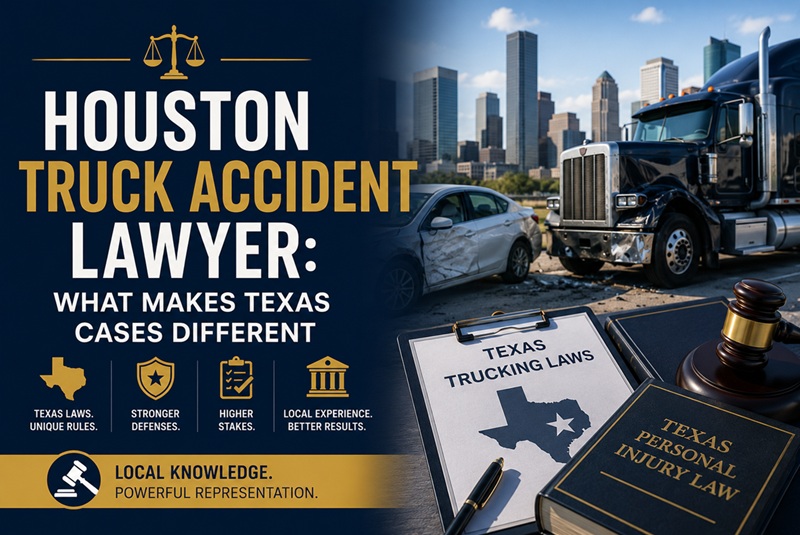
    Houston Truck Accident Lawyer: What Makes Texas Cases Different

    If you’ve been hit by a commercial truck in the Houston area, the lawyer you hire needs to understand three things that don’t apply in most other states: Texas’s HB 19 bifurcated trial rule for commercial vehicle cases, the state’s modified comparative negligence standard (the 51% bar), and the practical reality of litigating in Harris County and the surrounding district courts. A general personal injury attorney from outside Texas — or one who handles mostly car cases in Houston — won’t be equipped for the procedural maze that HB 19 created.

    The two-year statute of limitations on personal injury cases in Texas (codified at Tex. Civ. Prac. & Rem. Code § 16.003) is well known, but it isn’t the deadline that matters most. Evidence preservation is. The real clock starts the moment the crash happens, because trucking companies routinely send rapid-response teams to the scene within hours — and their insurers’ lawyers begin working before yours. A Houston truck accident lawyer who isn’t on the file within 48 hours of a serious crash is already behind.

    The HB 19 rule that changed truck cases in Texas

    Texas House Bill 19, which took effect September 1, 2021, fundamentally restructured how commercial truck lawsuits are tried in the state. Codified at Tex. Civ. Prac. & Rem. Code §§ 72.051–72.055, the law allows a defendant trucking company to demand a bifurcated trial — meaning the case is split into two phases:

    • Phase 1. The jury decides whether the truck driver was negligent and, if so, awards compensatory damages (medical bills, lost wages, pain and suffering).
    • Phase 2. Only if the plaintiff wins Phase 1, the jury then considers the trucking company’s direct liability (negligent hiring, training, supervision, maintenance) and any punitive damages.

    The defendant must file the motion for bifurcation within 120 days of filing their answer. Once requested, the court must grant it.

    What this means in practice: a significant portion of the most damaging evidence against trucking companies — prior safety violations, poor hiring practices, falsified logs, internal communications — is generally inadmissible in Phase 1. That evidence used to drive juries to award large verdicts on the spot. HB 19 made it harder.

    Why this requires a Houston-specific specialist

    The strategic and procedural implications of HB 19 are real. A truck accident lawyer working in Houston needs to:

    • Know how to admit company-level evidence in Phase 1 anyway. Section 72.053 allows evidence of regulatory violations in Phase 1 if the violation was a proximate cause of the injury and the regulation is specific to the defendant or the vehicle. Building that argument requires knowing exactly which FMCSR violations apply.
    • Use FMCSA Section 72.054(c) exceptions for federally regulated carriers. Most interstate truckers fall under federal motor carrier rules, which preserve certain plaintiff-friendly evidence in Phase 1.
    • Strategically frame causation early. A lawyer who doesn’t anticipate bifurcation when filing the lawsuit can find their case stripped of leverage by motion practice.

    Texas’s 51% bar rule

    Texas follows a modified comparative negligence standard. If you’re found to be 51% or more at fault for the crash, you recover nothing. If you’re 50% or less at fault, your recovery is reduced by your percentage of fault.

    Your Fault Recovery
    0% Full damages
    20% 80% of damages
    49% 51% of damages
    50% 50% of damages
    51% or more Nothing

    This makes early defense narratives extremely dangerous. If a trucking company can credibly assign just over half the fault to the injured driver, the entire case collapses. A good Houston truck accident lawyer attacks this narrative aggressively from week one.

    Local Houston factors

    Truck traffic in the Houston region is unusually heavy because of:

    • Interstate 10 and Interstate 45 corridors moving cargo east-west and north-south.
    • The Port of Houston, one of the largest ports in the U.S., generating constant container-truck activity.
    • The Energy Corridor and refinery traffic creating dense commercial vehicle movement around west and east Houston.
    • Beltway 8 and the Sam Houston Tollway as primary trucking arteries.

    A Houston-based truck accident lawyer is familiar with which courts the case might land in (Harris County district courts, possibly federal court if there’s diversity jurisdiction), local defense firms, and the typical demeanor of Houston juries — which has shifted over the past decade.

    Questions to ask a Houston truck accident lawyer

    • How many commercial vehicle cases have you handled post-HB 19?
    • What’s your strategy for getting company-level evidence admitted in Phase 1?
    • Are you in Harris County district courts regularly?
    • Who is your in-house or contracted accident reconstructionist?
    • Have you tried a truck case to verdict since 2021?

    The lawyers who specialize in this area answer these questions in detail. Generalists hesitate.

    This article is for general information and is not legal advice. If you’ve been involved in a truck accident in Texas, consult promptly with a licensed Texas attorney about your specific situation.

  • Best Auto Accident Lawyer: A Timeline of What They Actually Do for You

    Best Auto Accident Lawyer: A Timeline of What They Actually Do for You

    The best auto accident lawyer isn’t just someone who shows up at the end to negotiate a settlement — it’s someone whose work matters most in the first 30 days after the crash and again at very specific later points in your case. Understanding that timeline is how you tell a competent attorney from a passive one, and how you avoid the most common mistake injured drivers make: hiring late and losing leverage they didn’t know they had.

    If you’ve been in an auto accident, what your lawyer does in week one usually determines what your case is worth in month twelve. Below is the actual timeline of what a good auto accident lawyer handles, what you should expect from them at each stage, and the deadlines that don’t wait for anyone.

    Days 1 to 7: Evidence and medical foundation

    This window is where cases are won or lost, and most victims don’t realize it. A good auto accident lawyer is doing the following before the bruises have faded:

    • Sending preservation letters. To the other driver’s insurer, any commercial entity involved, and businesses with potential surveillance footage. Camera systems often overwrite within 30 days; some within 72 hours.
    • Securing the police report. Filed reports sometimes contain errors that need correcting before insurance adjusters lock them into their evaluation.
    • Documenting injuries medically. Without contemporaneous medical records, insurers argue your injuries weren’t caused by the crash. Even minor pain should be documented at urgent care or a doctor’s office in week one.
    • Photographing the vehicles before repair. Insurance companies push fast repair to control narratives. Your lawyer wants photos of damage from every angle before that happens.
    • Talking to witnesses while their memory is fresh.

    Days 8 to 30: Investigation and insurance posture

    The middle of the first month is when your lawyer establishes the relationship with the at-fault driver’s insurer:

    • Sending the formal letter of representation (which stops the insurer from contacting you directly).
    • Opening the claim, requesting policy limits, and identifying all available coverage (the at-fault driver’s policy, your own underinsured motorist coverage, umbrella policies).
    • Beginning the demand package — the document that will eventually drive settlement negotiations.

    This is also when you, the client, should be in active medical treatment if injured. Settlement value tracks medical documentation. A lawyer who tells you to “just rest and call us when you’re better” is missing the picture.

    Days 31 to 180: Treatment, demand, negotiation

    Most cases settle in this window. The pattern usually goes:

    • You complete your medical treatment or reach maximum medical improvement (MMI) — the point where further treatment won’t significantly change your condition.
    • Your lawyer compiles a demand package: medical records, bills, lost wage documentation, and a written argument for damages.
    • The insurer responds with an initial offer (usually low).
    • Two to four rounds of negotiation follow.

    A good auto accident lawyer doesn’t accept the first offer and doesn’t rush to settle just to close the file. They also tell you honestly whether their counter-demand is realistic or aspirational.

    Months 6 to 24: Lawsuit, if needed

    If the insurer won’t offer fair value, your lawyer files a lawsuit. From there:

    • Discovery phase (usually 6 to 12 months): depositions, document requests, expert reports.
    • Mediation (often before trial): a settlement conference with a neutral mediator. Many cases settle here.
    • Trial (rare in absolute terms — around 5% of auto accident cases): a jury or judge decides damages.

    Only attorneys who actually try cases regularly carry weight in this phase. Insurance companies track which lawyers settle reflexively and which will take a case to verdict.

    Key deadlines you can’t miss

    Deadline Typical Window
    Filing an insurance claim Most policies: within days to a week
    Reporting crash to your own insurer Usually 24 to 72 hours, even if not at fault
    Statute of limitations (personal injury) 1 to 6 years depending on state (often 2 to 3)
    Statute of limitations (property damage) Often longer than injury, sometimes shorter
    Uninsured motorist claim notice Sometimes 30 to 60 days
    Government claims (if a government vehicle was involved) Often 30 to 180 days — much shorter than regular cases

    The government-claim deadline trap is real. If a city bus or police vehicle was involved, you may have only weeks to file a formal notice — long before the regular statute of limitations would expire.

    What separates a good lawyer from an average one

    Two things, mostly:

    • They move fast in the first 30 days. If your lawyer can’t tell you exactly what they did in your first week, they probably didn’t do much.
    • They prepare every case as if it might go to trial. Even though most settle, the ones that get top-tier settlements are the ones the insurer believes will actually be tried.

    This article is for general information and is not legal advice. Consult with a licensed attorney about your specific situation.

  • Trucking Accident Lawyer: Why the Most Important Evidence Lives in Federal Records

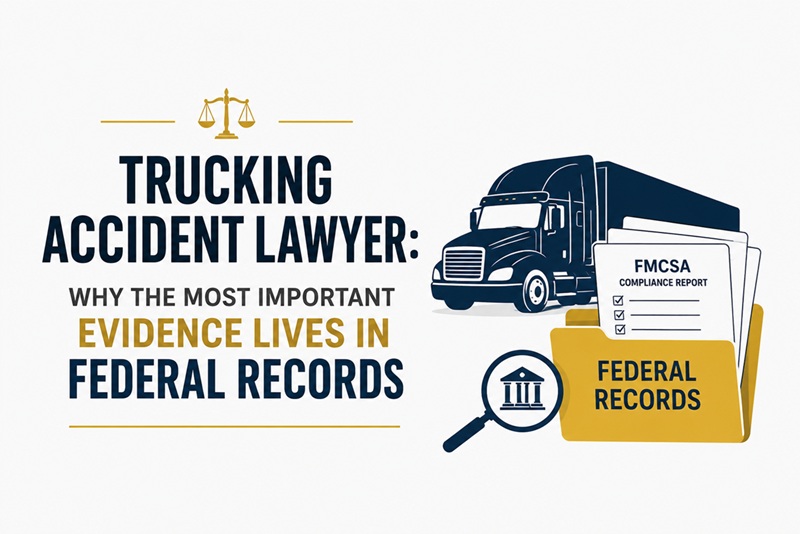
    Trucking Accident Lawyer: Why the Most Important Evidence Lives in Federal Records

    The most important documents in a trucking accident case are rarely at the crash scene. They’re in the carrier’s compliance files: electronic logging device data, hours-of-service records, drug and alcohol test results, driver qualification files, and vehicle inspection reports. A trucking accident lawyer who knows how to identify, preserve, and use these federal records is the difference between a settlement based on the police report and one built on documented regulatory violations — and the gap between those two outcomes is often hundreds of thousands of dollars.

    This is why “personal injury lawyer” and “trucking accident lawyer” are not interchangeable terms. Commercial vehicle cases are governed by the Federal Motor Carrier Safety Regulations (FMCSR) on top of state law, and finding violations requires knowing exactly what to ask for, when to ask for it, and how the trucking company is required to retain it.

    The federal records that often decide cases

    Commercial carriers operating in interstate commerce are required by FMCSA to keep specific records. Here’s what an experienced trucking accident lawyer goes after immediately:

    Record What It Shows Retention Period
    Electronic logging device (ELD) data Hours driven, on-duty time, exact location/time of stops 6 months (driver must retain 8 days)
    Driver qualification file License, medical certification, training, employment history Duration of employment + 3 years
    Drug and alcohol test results Pre-employment, random, post-accident testing 1 to 5 years depending on test type
    Driver vehicle inspection reports (DVIRs) Pre-trip and post-trip mechanical checks 3 months
    Maintenance records All repairs, inspections, parts replacements 1 year (12 months for current vehicles)
    Hours of service logs Historical driving and rest time 6 months
    Dispatch records Loads assigned, deadlines, routes Varies
    Post-accident testing Drug and alcohol screening after the crash Required within specific time windows

    Notice the retention periods. DVIRs and ELD records can be lawfully destroyed in as little as three to six months. If a trucking accident lawyer doesn’t send a preservation (spoliation) letter within days of the crash, these documents may legally disappear before discovery begins.

    The hours-of-service rules

    Driver fatigue is a leading factor in commercial truck crashes. FMCSA limits driving time through three main rules that trucking accident lawyers know cold:

    • 11-hour driving limit. A driver may drive up to 11 hours after 10 consecutive hours off duty.
    • 14-hour on-duty limit. A driver may not drive after the 14th hour following the start of the work day, even with breaks.
    • 70-hour/8-day limit (or 60-hour/7-day). Total on-duty time may not exceed 70 hours in any 8 consecutive days for carriers operating every day.
    • 30-minute break. Required after 8 cumulative hours of driving.

    When ELD data shows a driver exceeded these limits before the crash, the case fundamentally changes. Hours-of-service violations are direct, documented evidence of unsafe operation — and federal courts have repeatedly admitted them as proof of negligence.

    How violations become leverage

    A trucking accident lawyer doesn’t just collect compliance records — they use them strategically. A few patterns that recur:

    • Driver fatigue. ELD data showing hours-of-service violations near the time of the crash typically increases settlement value substantially.
    • Negligent hiring. A driver qualification file revealing prior crashes, failed drug tests, or suspended CDLs at hire date opens the door to direct negligence claims against the trucking company itself.
    • Improper maintenance. A maintenance log showing skipped or delayed inspections can support claims of negligent maintenance — often against both the carrier and a third-party contractor.
    • Falsified logs. When paper logs and ELD data don’t match, or when fuel receipts contradict the driver’s recorded location, that pattern alone can swing a jury.

    Why most general PI firms struggle here

    A general personal injury attorney might handle a few truck cases a year. Trucking accident lawyers — those who specialize — handle them every week. The practical difference shows up in three places:

    • Knowing what to demand and when. The first 30 days of evidence preservation determine what’s available at trial.
    • Knowing what the records mean. A DVIR with checkmarks looks fine to a non-specialist. A specialist notices that the same brake issue was flagged and then unflagged across multiple inspections.
    • Knowing which experts to retain. Trucking safety experts, accident reconstructionists, biomechanical engineers, vocational economists — the right combination depends on the facts.

    The bottom line for victims

    If you’ve been hurt in a trucking accident, the first practical question isn’t “should I hire a lawyer?” — it’s “how quickly can I hire one who actually does this work?” Get a free consultation within the first week if possible. Ask about FMCSR familiarity and spoliation procedures specifically. The lawyers who do this every day will know exactly what you’re asking.

    This article is for general information and is not legal advice. Consult with a licensed attorney in your state about your specific situation.