

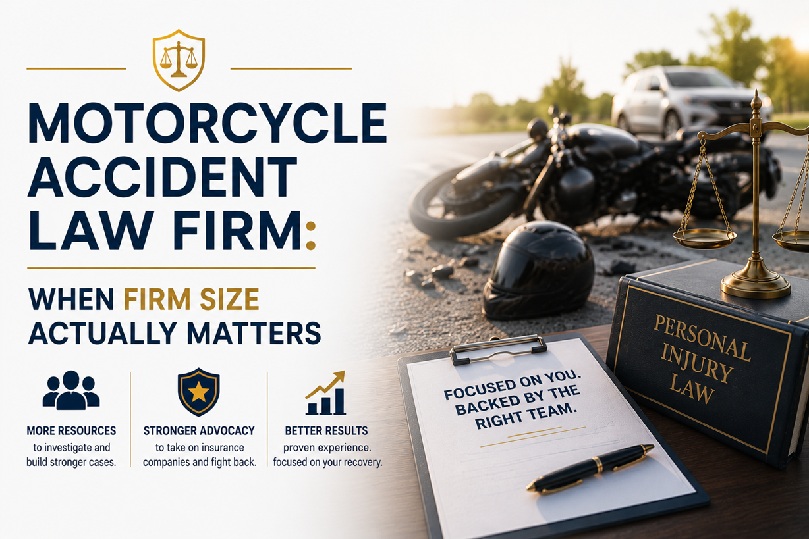
When you are searching for a motorcycle accident law firm, firm size matters more than it does in ordinary car accident cases — and bigger is not always better. A solo attorney with deep motorcycle case experience can deliver an excellent result for a clear-liability case with moderate injuries. A larger firm with internal investigators, expert relationships, and trial-tested attorneys often makes a six-figure difference in settlement value on catastrophic cases. The right choice depends on injury severity, liability complexity, and how aggressively the at-fault party’s insurance defense will fight back.
What you are really hiring is a team: the attorney, the paralegals, the investigators, the expert witnesses, and the firm’s capacity to advance tens or hundreds of thousands of dollars in litigation expenses before any verdict. Different firm structures handle that capacity differently, and the gap shows up directly in case value. The American Association for Justice, which maintains directories of trial-tested personal injury attorneys, can be a useful starting point — but the directory alone does not tell you whether a firm is the right structural fit for your specific case.
Solo, small, mid-size, big: what each means
| Firm Type | Strengths | Weaknesses | Best Fit |
| Solo attorney (1 lawyer) | Personal attention, direct access, low overhead | Limited capacity, no peer review | Clear-liability cases with moderate injuries |
| Small firm (2–10 lawyers) | Specialized focus, partner-level attention | Resource ceiling on the biggest cases | The sweet spot for most motorcycle cases |
| Mid-size firm (10–50 lawyers) | Resources for catastrophic cases, in-house specialists | Possible delegation to associates | Serious injury, multiple defendants |
| Large PI firm (50+ lawyers) | Maximum resources, trial bench depth | Can be impersonal, settlement mill risk | Catastrophic injury, complex cases |
Resources that actually matter in a motorcycle case
Beyond the lawyer themselves, several supporting capabilities affect case value. According to NHTSA motorcycle safety reports, motorcyclists are significantly overrepresented in fatal crash statistics relative to miles traveled — and the severity of injuries makes the supporting cast of experts critical:
- In-house or contracted investigators for scene visits, witness location, and surveillance camera retrieval in the first 72 hours.
- Standing relationships with accident reconstructionists. Top reconstructionists charge $300 to $600 per hour; total case cost often runs $15,000 to $40,000.
- Medical experts — orthopedic surgeons, neurologists, physiatrists who can testify on causation and prognosis.
- Life care planners, essential for catastrophic injuries; they project lifetime care costs.
- Vocational economists who calculate lost earning capacity.
- Trial-experienced lawyers on staff. Even if your case settles, the credible threat of an experienced trial team raises the offer.
- Case expense financing. Big cases require advancing $50,000 to $250,000 in expert and litigation costs.
A solo attorney can access all of these by contract, but each comes with friction, cost, and coordination overhead. A firm that does this work regularly has standing relationships and pre-vetted experts.
When a solo attorney is the right choice
A solo motorcycle accident attorney with the right experience can be an excellent choice when:
- Liability is clear (you were rear-ended at a stoplight, or the other driver crossed into your lane).
- Injuries are documented but not catastrophic — broken bones, road rash, soft tissue injuries with an expected full recovery.
- There is one defendant with adequate insurance coverage.
- You value direct access to your lawyer over having a layered support team.
When firm resources are decisive
A firm with deeper resources typically outperforms a solo when:
- The injury is catastrophic — traumatic brain injury, spinal cord injury, amputation, severe disfigurement, or wrongful death.
- Multiple defendants are involved (commercial driver plus employer, multiple at-fault parties, defective parts).
- Liability is contested and requires expert reconstruction and adverse witness depositions.
- The defense is represented by a large insurance defense firm with substantial resources.
- The case will likely go to trial.
In those scenarios, the gap between case value with adequate resources versus inadequate resources is often hundreds of thousands of dollars.
The settlement mill warning still applies
A large law firm is not automatically better than a small one. The biggest personal injury firms in many cities are settlement mills that rely on case volume, run cases through assembly-line processes, and rarely take a case to verdict. They generate massive ad budgets and steady cash flow — but their cases tend to settle for less than smaller, more selective firms can negotiate. Signals to watch for regardless of firm size:
- The attorney handling your case is a partner or senior associate, not a new lawyer.
- They turn down cases that do not fit their practice.
- They give realistic case value ranges, not aspirational figures.
- They have verifiable jury verdicts, not just total settlement claims.
- Communication is direct: you can reach your attorney, not just the firm.
How to choose, practically
- Take three free consultations. Compare what each firm says about the case.
- Ask directly about resources: “If this case needs an accident reconstructionist and a life care planner, how do you handle it?” The answer should be confident and specific.
- Match firm size to case complexity. Straightforward cases — solo or small firm. Complex cases — prioritize resources over personal touch.
The right motorcycle accident law firm is not the biggest one in town. It is the one whose structure fits the case you actually have.